- Never run for a bus.
- Please hold backpacks and other items to make room for others.
- Watch your step while getting on and off the bus, especially in winter conditions.
- If standing, always hold the grab rails or straps for balance.
- Keep the aisle clear.
- For your own safety, stand behind the yellow line at the front of the bus.
- Bare feet, skates or rollerblades are not allowed. Shirts must be worn at all times.
- Move to the back of the bus to make room for passengers getting on.
- Don't walk to the exit doors until the bus has come to a complete stop.

Safety and Travel Tips
General safety tips
Safety is our top priority. We kindly ask that you stay alert and aware of your surroundings.
Report anything suspicious to your operator, such as:
- Unattended backpacks or bags
- Suspicious behaviour
- Anything that appears to be unusual
- Assist children when getting on and off the bus.
- Children must always be seated.
- Don't allow children to put their hands or head out of the window or play in the aisle.
- If your child is lost, frightened, hurt, or in trouble, an operator can notify emergency services to help.
New railway crossing procedures
Starting September 29, 2025, Durham Region Transit (DRT) is updating how buses travel through protected railway crossings.
These updates are consistent with the Toronto Transit Commission (TTC), Metrolinx and Grand River Transit.
What is a protected railway crossing?
A protected railway (below) crossing is marked with a crossbuck and includes one or both of the following:
- Flashing signal lights.
- A gate arm that lowers and raises when trains approach.
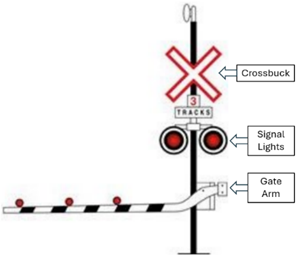
Unprotected railway crossings (below), marked only with a crossbuck and no active warning devices, are not affected by this update.

What customers may notice:
At protected railway crossings, bus operators will:
- Reduce speed as they approach.
- Stop when signal lights flash or the gate arm lowers.
- Wait until the warning devices are deactivated, the gate is fully upright, and the tracks are clear before proceeding.
This may mean a brief pause during your trip, but it is an important part of keeping everyone safe.
Why this matters:
- Aligns DRT with partner transit systems.
- Creates consistency for customers and operators across the Greater Toronto Area.
- Enhances safety on every trip.
Emergencies
If you need assistance, speak to your operator as soon as possible. They will notify emergency services to assist. If lost, ask your operator for help.
To view a list of DRT’s Emergency Preparedness and Response policies, along with instructions on how to access them, visit this link.
Be prepared
Travel with your mobile device or phone if you have one. It can be a valuable resource to access important information and travel tools.
Carry some emergency money or a few extra tickets with you in case you lose your pass or PRESTO card.
Stop Request Program
When customers express a safety concern at night, or when the operator determines that it's unsafe to serve a stop, the operator will attempt to stop at a different safe location to let customers off the bus. Let the operator know at least one stop ahead of where you would like to get off the bus and they will try to safely and smoothly meet your request.